


For a publicly listed mineral exploration company, few disclosure events have the potential to move the market as quickly—or as dramatically—as the release of drill results.
A significant intersection can change the market’s perception of a mineral project overnight. Equally, a series of unsuccessful holes can materially alter an emerging geological thesis. This makes drill-result disclosure more than a technical compliance exercise; it is an important component of an issuer’s continuous disclosure obligations, investor relations strategy, and overall disclosure controls.
For mineral exploration issuers listed on the Toronto Stock Exchange, the TSX Venture Exchange or the Canadian Securities Exchange, drill-result disclosure sits at the intersection of National Instrument 43-101 — Standards of Disclosure for Mineral Projects (“NI 43-101”), securities law requirements governing timely disclosure and material changes, applicable stock exchange requirements and policies and the general prohibition against misleading disclosure.
While every exploration program is different, a useful guiding principle is straightforward:
Material drill results should be disclosed promptly, in appropriate geological context, and with sufficient information to allow a reasonable investor to understand both their significance and their limitations.
For exploration companies—particularly single-asset issuers—developing a disciplined approach to drill-result disclosure before assays begin arriving can significantly reduce regulatory, trading, and reputational risk.
Five rules for management
For management teams overseeing an active exploration program, five principles provide a useful starting point.
1. Decide how results will be disclosed before you know what they say.
Establish the issuer’s batching, materiality, blackout, review, and approval procedures before assays begin arriving. A policy developed in advance is much easier to defend than one that evolves in response to good or bad results.
2. Materiality is continuous.
Do not assume that disclosure can wait until completion of a drill program. A sufficiently significant result—or series of results—may become material while drilling remains underway. However, guard against disclosing incomplete results if they could be misleading.
3. Tell the whole geological story.
The market should receive a fair picture of the relevant drilling program. Positive results cannot be selectively emphasized while material negative results are withheld.
4. Context matters as much as grade.
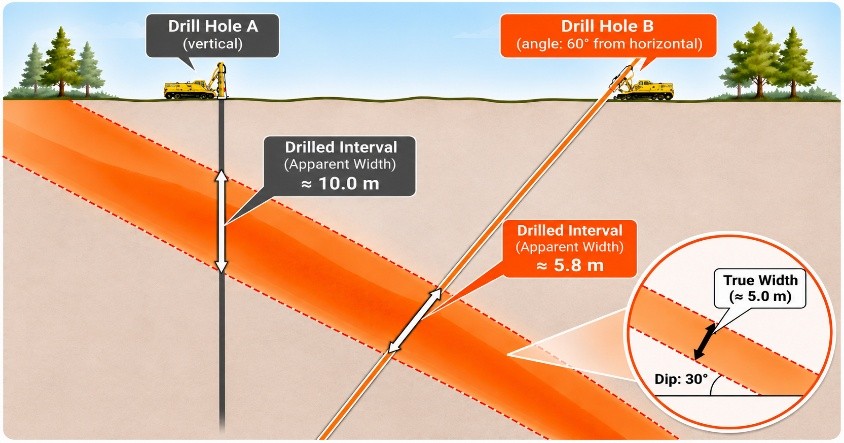
A spectacular assay without geometry, true-width information, geological interpretation, and surrounding drilling can be misleading. Explain why the intersection matters.
5. Treat all drill results as potentially market-sensitive information.
Control access, consider trading blackouts and avoid selective disclosure to analysts, investors, bankers, or conference participants. All drill results should be considered highly confidential until the information becomes generally disclosed.
Establish a disclosure protocol before the assays arrive
One of the most effective practices is also one of the simplest: establish a drill-result disclosure protocol before drilling begins. Management, the issuer’s Qualified Person (“QP”), and securities counsel should determine in advance how assay results will be received, reviewed, verified, assessed for materiality, and ultimately disclosed.
The protocol should address who receives assay results and has access to the assay database; applicable trading blackouts; QA/QC procedures; materiality assessment; the methodology for grouping results into disclosure batches; QP data verification review of the news release; management and legal approval; dissemination procedures; and, where appropriate, consultation with CIRO Market Surveillance.
Establishing these policies and procedures in advance reduces the risk that disclosure decisions will inadvertently become dependent upon whether particular drill results are favourable or unfavourable.
Materiality is necessarily contextual. A drill intersection that may not be material to a large, diversified producer could be highly material to a junior exploration company whose valuation is substantially attributable to a single mineral property.
Materiality does not wait for completion of the drill program
There is no general requirement that an issuer issue a news release each time an assay certificate arrives from the laboratory. Issuers require reasonable time to complete QA/QC procedures, have the QP verify the data and review the news release, understand the geological significance of results, and assemble individual assays into technically meaningful disclosure.
Drill results can, however, be a material change on their own. In Pezim, the Supreme Court of Canada upheld a finding that undisclosed drill results were a material change for an exploration issuer, because the new information they provided about a mineral property bore significantly on the question of that property’s value.[1] In Lundin Mining, the Court confirmed that “material change” is to be read broadly. An issuer whose drill results are a material change must issue a news release immediately and file a material change report within 10 days.
An issuer should therefore be cautious about delaying disclosure of information that has become sufficiently reliable, complete, and material simply because a larger drill program remains underway or because management would prefer to release results according to a predetermined investor relations calendar.
For active drilling programs, a practical approach is often to establish regular and geologically coherent reporting batches. Results might be grouped by target, drill fence, mineralized zone, phase of drilling, or another technically supportable basis.
The key is consistency. A disclosure practice that accelerates exceptionally positive results while accumulating disappointing results for significantly longer periods may attract regulatory scrutiny and can create a misleading picture of the exploration program.
Report the exploration program—not just the best holes
Selective disclosure of successful drill holes represents one of the most significant risks in exploration disclosure. Canadian continuous disclosure principles do not permit an issuer to disclose favourable developments while withholding material unfavourable developments. National Policy 51-201 ‒ Disclosure Standards emphasizes that unfavourable news must be disclosed as promptly and completely as favourable news.
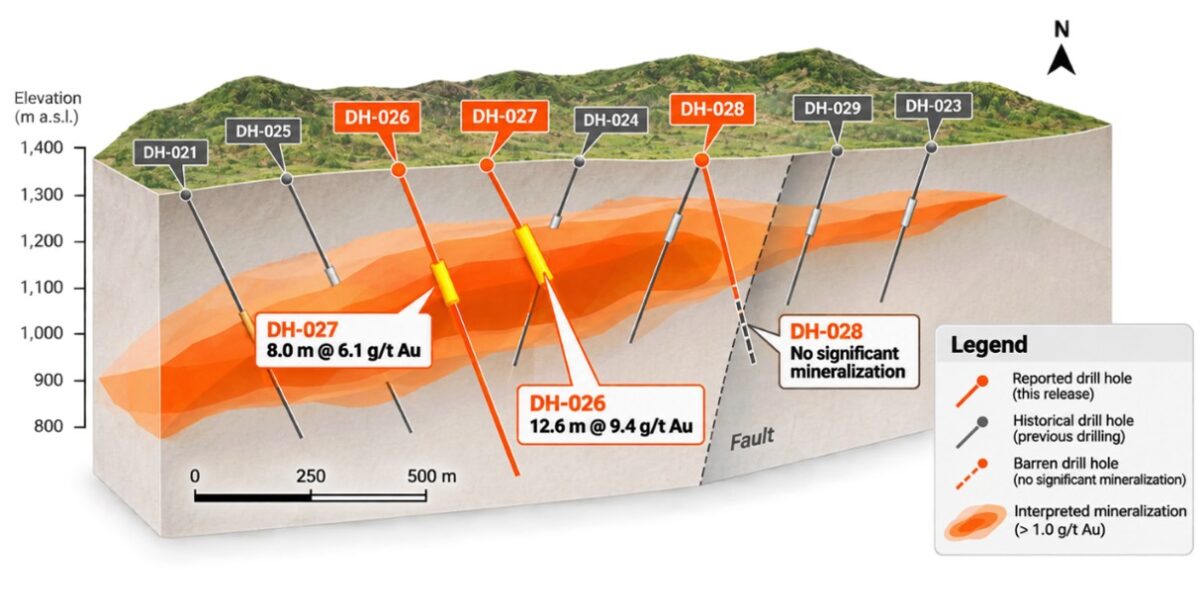
This does not mean that every insignificant assay must appear in a news release. It does mean that disclosure should allow investors to understand the results of the relevant exploration program fairly. Issuers should account for every hole in the drill program being reported and, where partial results are released, should disclose the balance in a timely manner whether favourable or unfavourable.[2] In practice, a drill table can identify holes containing “no significant mineralization” or “NSI”, accompanied by disclosure explaining the threshold the issuer has used in determining significance.
Give investors the geometry
Grade and drilled interval alone rarely tell the complete geological story. NI 43-101 requires specified technical information concerning exploration results, including information regarding sample location and type, drill-hole location, azimuth and dip, sample intervals, analytical results and, to the extent known, true widths.
Accordingly, drill-result disclosure should generally provide sufficient information for a technically informed reader to understand the geometry of the intersection. A well-constructed drill table will typically include:
| Hole | From | To | Drilled Interval | Grade | Estimated True Width |
|---|---|---|---|---|---|
| ABC-26-041 | 212.0 m | 229.5 m | 17.5 m | 6.42 g/t Au | ~14.1 m |
| including | 218.0 m | 224.0 m | 6.0 m | 13.7 g/t Au | — |
| ABC-26-042 | — | — | — | NSI | — |
Collar coordinates, elevation, azimuth, and dip should also be disclosed where applicable. Where true width is unknown, the issuer should say so clearly rather than allowing investors to assume that drilled interval approximates true thickness. This becomes particularly important in early-stage discoveries where the orientation and geometry of mineralization remain uncertain.
Explain why the hole matters
The strongest exploration disclosure does more than reproduce an assay certificate. Investors should be told what the result means in the context of the mineral property’s geological model. A drill hole may extend known mineralization along strike or at depth, test a previously undrilled step-out, demonstrate continuity, identify a new mineralized structure, provide infill information, or materially change the issuer’s geological interpretation of the mineral property.
For significant results, a well-designed plan map and cross-section can be more informative than several paragraphs of description. Graphics should clearly identify the location of reported holes relative to previous drilling, known mineralization and relevant geological features, using scales and orientations that permit meaningful comparison.
Exercise discipline in headlines and with promotional language
The headline is often the most widely consumed portion of an exploration news release. It should communicate the objectively significant result without exaggerating its geological implications.
For example:
“ABC Gold intersects 12.6 g/t Au over 9.0 metres in 100-metre step-out at Zone X”
generally conveys more useful information than:
“ABC Gold delivers another spectacular bonanza-grade discovery”
Terms such as “world class,” “spectacular,” “exceptional,” “transformational,” and “bonanza” should be used cautiously, if at all, unless technically supportable and appropriately contextualized. These words are promotional and inherently imply a comparison to other undisclosed mineral projects. Rather than use promotional words, issuers should allow the data and information to speak for themselves within the context of the issuer’s thesis and narrative as a whole.
Issuers should also exercise care with grade × thickness calculations. While useful shorthand in some circumstances, they can obscure important geological differences and may be misleading where true width is uncertain, mineralization is highly variable or an interval is disproportionately influenced by an exceptionally high-grade assay. NI 43-101 also restricts two related shortcuts: an issuer must not disclose the gross value of the metal or mineral in a sampled interval or drill intersection and must not disclose a metal or mineral equivalent grade unless it also discloses the grade of each metal or mineral used to establish that equivalent grade.
Make high-grade outliers transparent
High-grade deposits frequently produce individual assays that materially influence the reported grade of a broader interval. For example, a reported intersection of:
10.0 metres grading 20.0 g/t Au
may contain:
0.5 metres grading 350 g/t Au.
That information can be highly relevant to an investor’s interpretation of the broader interval. NI 43-101 requires an issuer that discloses sample or analytical results to disclose the results of any significantly higher-grade intervals within a lower-grade intersection. Where an exceptionally high-grade subinterval materially influences a reported composite, the issuer must identify it. Depending upon the circumstances, an issuer may also consider providing the broader interval both with and without the extreme assay or explaining any capping methodology that has been applied.
The objective is not to diminish a genuinely exceptional result. It is to ensure that investors understand what generated the reported grade.
QA/QC disclosure should be substantive
NI 43-101 requires appropriate disclosure concerning quality assurance and quality control measures. For a diamond drilling program, disclosure will commonly address:
- core recovery and logging
- sample security and chain of custody
- analytical methodology
- check assays or umpire laboratory procedures
- cutting and sampling
- laboratory preparation
- standards, blanks, and duplicates
- QP oversight
Boilerplate QA/QC language should not substitute for an actual review of the program. If QA/QC procedures identify a meaningful issue with a batch of assays, the issuer should resolve the issue before relying upon those results or clearly disclose the limitation.
The qualified person should be part of the disclosure process
NI 43-101 requires scientific and technical information concerning a mineral project to be based upon information prepared by or under the supervision of a QP or approved by a QP, as applicable. The QP should therefore be integrated into the issuer’s disclosure process rather than simply being asked to approve an investor relations draft immediately before publication.
NI 43-101 also requires written disclosure of scientific or technical information to name the responsible QP and state that QP’s relationship to the issuer. The disclosure must also state whether a QP has verified the data, describe how and with what limitations and explain any failure to verify.
For active exploration companies, an effective internal process may look like:
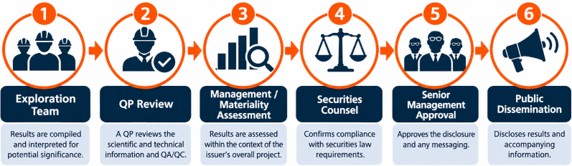
The QP’s role is particularly important where disclosure contains geological interpretation rather than merely reporting analytical results.
Protect undisclosed drill results
Potentially material drill results should be considered highly confidential and should initially circulate within a tightly controlled group based upon the need to know. Issuers should consider imposing or extending trading blackouts once potentially material results become known internally and should maintain appropriate controls over access to assay databases and technical information. Particular care should be taken in communications with analysts, investment dealers, institutional shareholders, prospective investors, strategic investors, counterparties, consultants and participants at conferences or site visits.
Canadian securities laws prohibit selective disclosure of material information. Management should therefore avoid providing incremental information that allows sophisticated market participants to infer undisclosed drill results.
A seemingly innocuous statement at a mining conference—such as management being “very excited about what we are seeing in the core”—can become problematic if the issuer is already in possession of material undisclosed technical information.
The same risk arises on social media. A post, a video from the drill site or a photograph of core is disclosure and can signal results as clearly as a news release. Core photos and descriptions of visible mineralization are a particular concern because they invite investors to infer grade before any assays have been received. Nothing about undisclosed results should appear on social media before the news release and that restriction should extend to the personal accounts of directors, employees, and contractors.
Negative results can be material results
A disciplined disclosure policy must account for unsuccessful drilling. The question is not whether a particular barren hole is inherently material. Frequently, it will not be. The more important question is whether unsuccessful drilling, individually or collectively, changes the information previously provided to the market.
Negative drilling may become material where it materially reduces the interpreted strike length of a mineralized zone, fails to confirm previously suggested continuity, undermines a geological model emphasized in earlier disclosure, sterilizes a significant target, causes management to discontinue a previously significant drill program or materially changes the issuer’s exploration strategy.
This is particularly important where earlier successful drilling has received extensive public attention. Disclosure obligations do not end simply because the geology becomes less interesting.
Before you press “release”: Ten questions to ask
Immediately before publication of a significant drill-results release, management, the QP, and counsel should be able to answer the following questions:
1. Have all of the results necessary to understand this batch been received, reviewed, and subjected to appropriate QA/QC and data verification?
2. Why are these particular holes being released together? Is there a defensible geological reason?
3. Are we releasing the good holes faster than we ordinarily release disappointing holes?
4. Does the release identify unsuccessful drilling where necessary to understand the program fairly?
5. Does the headline accurately describe the significance of the results without overstating them or being overly promotional?
6. Have we clearly distinguished drilled interval from true width?
7. Could an unusually high-grade subinterval be driving a headline composite in a manner investors should understand?
8. Do the maps and sections provide enough information to understand where these holes sit relative to previous drilling and known mineralization
9. Is anything management is currently telling analysts, investors, or conference participants more informative than what appears in the release?
10. If the results are materially worse than expected, would we be comfortable applying exactly the same disclosure standard?
If any of these questions cannot be answered with confidence, the release is not ready.
*****
This publication provides general information concerning Canadian securities law and stock exchange considerations and does not constitute legal advice. The application of securities laws and stock exchange requirements depends on the particular facts and circumstances, including the nature and materiality of the mineral property and the information concerned.
How Miller Thomson can help
If your team cannot confidently answer the ten questions above, the gap is worth closing before the next set of assays arrives. Miller Thomson’s mining lawyers advise exploration and development-stage issuers on drill-result disclosure protocols, NI 43-101 compliance, materiality assessments, and regulatory matters.
[1] Pezim v. British Columbia (Superintendent of Brokers), [1994] 2 S.C.R. 557 at p. 600.
[2] This guidance is mandatory for issuers with securities listed on the Toronto Stock Exchange or TSX Venture Exchange. See Toronto Stock Exchange Company Manual, Appendix B, Disclosure Standards for Companies Engaged in Mineral Exploration, Development & Production, and TSX Venture Exchange Corporate Finance Manual, Appendix 3F, Mining Standards Guidelines.